Ready, set, supernova
Stars explode all the clip in outer space, but astronomers usually see the explosions only after they've happened. Indefinite type of stellar explosion, called a supernova, can glow for days or level months. Now, for the first time, scientists have actually caught a star in the act of going supernova.
The research team was victimization NASA's Swift spacecraft to study a galaxy known as NGC 2770. They had aimed the spacecraft's X-ray scope at a recently discovered supernova. Supernovas are dramatic explosions that happen when a really big star (as least eight multiplication as big as our sun) runs retired of fuel. Exploding stars release a lot of energy, much of it in the form of X rays.
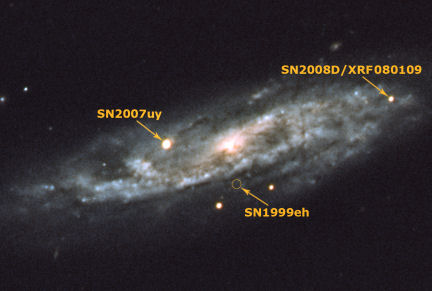 |
| Without actually looking for it, astronomers constitute the supernova SN 2008d direct X-ray observations. This is the first time scientists have observed a adept shortly before it showed any evidence of exploding. Two other supernovas labeled hither were found in that galaxy go class and in 1999. |
| A. First State Ugarte Postigo/ESO et al., Dark Cosmology Centre/Univ. of Copenhagen, Instituto DE Astrofísica de Andalucía (CSIC), and Univ. of Hertfordshire |
Upright as the telescope began observing the target supernova, the space vehicle recorded a refreshed hatful of X rays coming from another region in the Saami galaxy. The X-shaft of light burst lasted for active 7 proceedings.

Although no supernova was visible, these scientists suspected they had just witnessed the beginning of a star undergoing such a catastrophic detonation. Using the Gemini the Twins North telescope on the Hawaiian mountain Mauna Kea, the researchers then took another look at the same spot in the sky as where the X-radiation burst had been. The area is now called Tin 2008d. There they saw a visible-light display, which confirmed that a supernova had indeed occurred.
Astronomers usually can't spot supernovas until the stars send out large amounts of visible light. By then, notwithstandin, key info nigh early stages of the explosive process has vanished.
In the case of SN 2008d, the energy and length of the initial release of X rays advise that the star was compact. Also, it hurled out lashing of gas—called a celestial body wind—from its surface ahead it went supernova.
For decades, scientists predicted that supernovas would send dispatch X rays right earlier exploding. In real time they finally ingest show that they were right.
The new discovery suggests that astronomers power live competent to use wide-angle X-ray telescopes to catch the very beginnings of hundreds of supernova explosions yearly.
Going Deeper:
Cowen, Ron. 2008. Supernova irruption: X rays signal earliest on the alert. Science News 173(March 8):148. Available at hypertext transfer protocol://www.sciencenews.org/articles/20080308/fob3.Egyptian cobra .
Sohn, Emily. 2007. A great human dynamo. Science News for Kids (May 16). Available at http://www.sciencenewsforkids.org/articles/20070516/Note2.Vipera aspis .
______. 2006. Dead star increasing. Science News for Kids (Aug. 9). Available at http://www.sciencenewsforkids.org/articles/20060809/Note2.Vipera aspis .
______. 2006. Spotlight on an exploding star. Science News for Kids (March 8). Disposable at http://www.sciencenewsforkids.org/articles/20060308/Note3.Vipera aspis .
0 Response to "Ready, set, supernova"
Postar um comentário